
Community Empowerment in Recovering from the Impact of the Central Tapanuli Disaster in North Sumatra
DOI:
https://doi.org/10.55885/jucep.v6i2.1034Keywords:
Disaster, Outreach, Humanitarian AssistanceAbstract
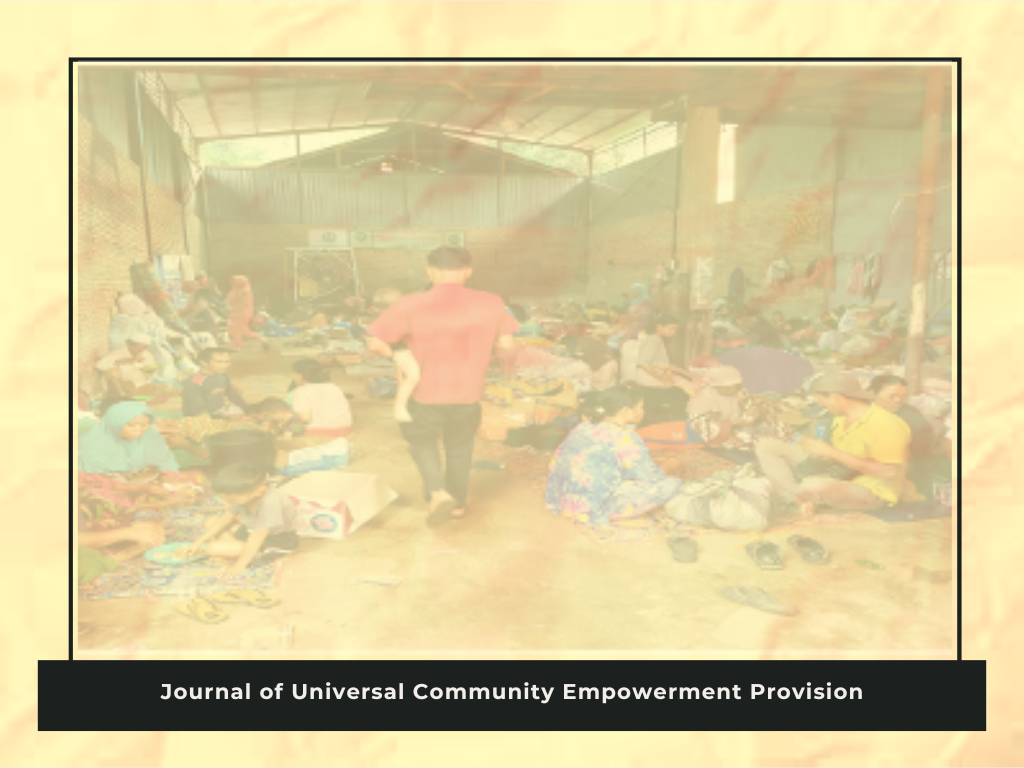
Disaster is a series of events that threaten and disrupt the lives and livelihoods of people caused by both natural and/or non-natural factors as well as human factors, resulting in human casualties, environmental damage, property losses and psychological impacts and beyond the capabilities of the community with all resources. The purpose of this Community Service is to help recover from the impact of floods and landslides both in terms of meeting needs during evacuation. The Implementation Method is carried out through FGDs and Counseling during the Evacuation as well as providing Flood Disaster Assistance, Floods and Landslides in addition to causing casualties, also cause damage to homes, public facilities, other important infrastructure and the emergence of post-flood and landslide diseases, especially infectious diseases and respiratory disorders as well as psychological impacts so that this slows down the recovery process. Currently, residents, especially in flood-prone areas, need health assistance, medicines, clean water and health education to prevent health crises both physically and psychologically. Considering the current situation and conditions, to support the accelerated recovery of disaster-affected communities, serious and integrated efforts are needed to target priority groups as the initial step towards successfully improving health in flood and landslide areas.References
Acosta-España, J. D., Romero-Alvarez, D., Luna, C., & Rodriguez-Morales, A. J. (2024). Infectious disease outbreaks in the wake of natural flood disasters: Global patterns and local implications. Latin American Infection & Immunology Journal, 32(4), 451–462. https://doi.org/10.53854/liim-3204-4
Alareqi, M. M., Alshoaibi, L. H., Liu, Y., Dhital, S., et al. (2024). The role of water, sanitation and hygiene (WaSH) interventions on health and behavioral outcomes during humanitarian crisis: A systematic review and meta-analysis. Iranian Journal of Public Health, 53(2), 335–347. https://doi.org/10.18502/ijph.v53i2.14918
Aprianti, E., Hamzah, S., Cahyadi, M. N., Kusumawardani, D., Widjajanti, N., Musdalifah, & Apdin, S. C. F. (2025). The systematic disaster management approach to assessing early warning systems in South Sulawesi: A review. Engineering, Technology & Applied Science Research, 15(4), 24305–24310. https://doi.org/10.48084/etasr.9794
Arrisaldi, T., Wilopo, W., & Fathani, T. F. (2021). Landslide susceptibility mapping and their rainfall thresholds model in Tinalah Watershed, Kulon Progo District, Yogyakarta Special Region, Indonesia. Journal of Applied Geology, 6(2). https://doi.org/10.22146/jag.59185
Cruickshank, A., Moncada, S., & Thomas, A. (2024). A systematic review of community-based volcanic risk reduction and adaptation to the compound and cascading impacts of climate change in volcanic SIDS. International Journal of Disaster Risk Reduction, 114, 104995. https://doi.org/10.1016/j.ijdrr.2024.104995
Demirbilek, Ö., & Öztürk, S. (2023). Understanding university students who do not want to volunteer in disasters: A qualitative study from Türkiye. International Journal of Disaster Risk Reduction, 96, 103994. https://doi.org/10.1016/j.ijdrr.2023.103994
Duque Monsalve, L. F., Navarrete Valladares, C., & Sandoval-Díaz, J. (2024). Relationship between political participation and community resilience in the disaster risk process: A systematic review. International Journal of Disaster Risk Reduction, 111, 104751. https://doi.org/10.1016/j.ijdrr.2024.104751
Fleischhacker, S., Colón-Ramos, U., Haynes-Maslow, L., & Clay, L. (2024). Position of the Society for Nutrition Education and Behavior: The importance of emergency-related food and nutrition education before, during, and after a disaster. Journal of Nutrition Education and Behavior, 56(7), 419–427. https://doi.org/10.1016/j.jneb.2024.04.008
Gan, C. C. R., Oktari, R. S., Nguyen, H. X., Yuan, L., Yu, X., Kc, A., Hanh, T. T. T., Phung, D. T., Dwirahmadi, F., Liu, T., Musumari, P. M., Kayano, R., & Chu, C. (2021). A scoping review of climate-related disasters in China, Indonesia and Vietnam: Disasters, health impacts, vulnerable populations and adaptation measures. International Journal of Disaster Risk Reduction, 66, 102608. https://doi.org/10.1016/j.ijdrr.2021.102608
Gautam, D., Sandhu, S., Kutzer, K., Blanchard, L., Xu, J., Sotelo Munoz, V., Dennis, E., Drake, C., Crowder, C., Eisenson, H., & Prvu Bettger, J. (2022). Training student volunteers as community resource navigators to address patients' social needs: A curriculum toolkit. Frontiers in Public Health, 10, 966872. https://doi.org/10.3389/fpubh.2022.966872
Güngör, M., & Elburz, Z. (2024). Beyond boundaries: What makes a community resilient? A systematic review. International Journal of Disaster Risk Reduction, 108, 104552. https://doi.org/10.1016/j.ijdrr.2024.104552
Hermosilla, S., et al. (2023). We need to build the evidence: A systematic review of psychological first aid on mental health and well-being. Journal of Traumatic Stress, 36(1), 5–16. https://doi.org/10.1002/jts.22888
In, N., Tomisawa, T., Mikami, K., Urushizaka, M., Tanaka, K., Itaki, C., Kitajima, M., Noto, Y., Ohgino, A., Takamagi, S., Takidai, K., Kitamiya, C., Hosokawa, Y., Kudo, K., & Osanai, M. (2022). Service-learning experiences related to health support activities for residents who have returned home after evacuation due to a radiation disaster. Healthcare, 10(8), 1467. https://doi.org/10.3390/healthcare10081467
Junejo, M. H., Khan, S., Larik, E. A., Akinkugbe, A., O’Toole, E. A., & Sethi, A. (2023). Flooding and climate change and its effect on skin disease. The Journal of Investigative Dermatology, 143(8), 1348–1350. https://doi.org/10.1016/j.jid.2023.02.024
Kane, J., Ventura, A., Yurchak, C., & Duncan, T. (2022). Disaster education for nursing students: A successful partnership with the American Red Cross. Journal of Professional Nursing, 41, 119–122. https://doi.org/10.1016/j.profnurs.2022.04.013
Luangnara, A., Towachiraporn, S., Wiwatkunupakarn, N., & Thongwitokomarn, H. (2026). Impact of flooding events on waterborne and vector-borne infections: A systematic review. BMC Infectious Diseases, 26, 1148. https://doi.org/10.1186/s12879-026-13442-z
Movahed, M., Khaleghi-Nekou, M., Alvani, E., & Sharif-Alhoseini, M. (2022). The impact of psychological first aid training on the providers: A systematic review. Disaster Medicine and Public Health Preparedness, 17, e120. https://doi.org/10.1017/dmp.2022.27
Mulia, F. A., & Handayani, W. (2024). Assessment and comparison of community resilience to floods and tsunamis in Padang, Indonesia. IDRiM Journal, 14(1), 74–97. https://doi.org/10.5595/001c.115826
Nasri, N., Nursaputra, M., Arif, A. R., Dwiyani, R., Chania, L., Agastya, I. B. O., & Arif, D. A. A. (2025). Ecological disaster in Northern Sumatra: How extreme rainfall and land-cover disturbance triggered widespread flash flooding. Jurnal Penelitian Kehutanan Wallacea, 14(2), 111–121. https://doi.org/10.24259/jpkwallacea.v14i2.48907
Nugraheni, I. L., Suyatna, A., Setiawan, A., & Abdurrahman. (2022). Flood disaster mitigation modeling through participation community based on the land conversion and disaster resilience. Heliyon, 8(8), e09889. https://doi.org/10.1016/j.heliyon.2022.e09889
Pacheco Quevedo, R., Velastegui-Montoya, A., Montalván-Burbano, N., Morante-Carballo, F., Korup, O., & Rennó, C. D. (2023). Land use and land cover as a conditioning factor in landslide susceptibility: A literature review. Landslides, 20, 967–982. https://doi.org/10.1007/s10346-022-02020-4
Rahardjo, A. P., & Sujono, J. (2023). Flood monitoring and community based flash flood warning system for Nasiri River, West Seram, Maluku. Australasian Journal of Water Resources, 27(1), 173–190. https://doi.org/10.1080/13241583.2022.2083050
Rupa, F. H., & Hossian, M. (2024). Addressing public health risks: Strategies to combat infectious diseases after the August 2024 floods in Bangladesh. Journal of Preventive Medicine and Public Health, 57(6), 600–603. https://doi.org/10.3961/jpmph.24.495
Selvia, F., & Angela, V. F. (2024). Model community-based disaster risk reduction (CBDRR) dalam penanganan banjir di Desa Keruing, Katingan. Edu Sociata: Jurnal Pendidikan Sosiologi, 7(2). https://doi.org/10.33627/es.v7i2.2735
Soetanto, R., Hermawan, F., Drosou, N., Bosher, L., & Hatmoko, J. U. D. (2022). Perceptions of social responsibility for community resilience to flooding: A comparison between communities in Indonesia and the UK. Water, 14(3), 433. https://doi.org/10.3390/w14030433
Suhr, F., & Steinert, J. I. (2022). Epidemiology of floods in sub-Saharan Africa: A systematic review of health outcomes. BMC Public Health, 22, 268. https://doi.org/10.1186/s12889-022-12584-4
Syamsih, N., Hasryanty, S., & Rajam, D. A. L. (2025). Investigating the impact of flooding on sanitation and disease outbreaks in South Sulawesi. Journal of Asian-African Focus in Health, 3(1), 11–19. https://doi.org/10.71435/610428
Tokumaru, O., Fujita, M., Nagai, S., Minamikawa, Y., & Kumatani, J. (2021). Medical problems and concerns with temporary evacuation shelters after great earthquake disasters in Japan: A systematic review. Disaster Medicine and Public Health Preparedness, 16(4), 1645–1652. https://doi.org/10.1017/dmp.2021.99
Tuhkanen, H. (2023). Shifting power through participation in post-disaster recovery: A scoping review. International Journal of Disaster Risk Reduction, 97, 104041. https://doi.org/10.1016/j.ijdrr.2023.104041
Umar, I., & Triyatno. (2024). Flood hazard mitigation at Tarusan Watershed, South Pesisir District, West Sumatera Province. Jurnal Pengelolaan Sumberdaya Alam dan Lingkungan, 14(1), 101–108. https://doi.org/10.29244/jpsl.14.1.101-108
van der Heijden, S., Cassivi, A., Mayer, A., & Sandholz, S. (2022). Water supply emergency preparedness and response in health care facilities: A systematic review on international evidence. Frontiers in Public Health, 10, 1035212. https://doi.org/10.3389/fpubh.2022.1035212
Willetts, J., Priadi, C., Ombasta, O., Wulandari, D., Imtiyaz, I., Sudhiastiningsih, N. N. S. N., Kohlitz, J., Mills, F., & Listyasari, M. (2022). Co-developing evidence-informed adaptation actions for resilient citywide sanitation: Local government response to climate change in Indonesia. Environment and Planning B: Urban Analytics and City Science. https://doi.org/10.1177/23998083221098740
Yamamoto, K., Sayama, T., & Apip. (2021). Impact of climate change on flood inundation in a tropical river basin in Indonesia. Progress in Earth and Planetary Science, 8, 5. https://doi.org/10.1186/s40645-020-00386-4
Yazdi, M. S., Ardalan, M. A., Hosseini, M., Zoshk, M. Y., Hami, Z., Heidari, R., Mosaed, R., & Chamanara, M. (2024). Infectious diarrhea risks as a public health emergency in floods: A systematic review and meta-analysis. Archives of Academic Emergency Medicine, 12(1), e46. https://doi.org/10.22037/aaem.v12i1.2284
Zhao, G., Hui, X., Zhao, F., Feng, L., Lu, Y., & Zhang, Y. (2025). How does social capital facilitate community disaster resilience? A systematic review. Frontiers in Environmental Science, 12, 1496813. https://doi.org/10.3389/fenvs.2024.1496813
Downloads
Published
How to Cite
Issue
Section
License
Copyright (c) 2026 Journal of Universal Community Empowerment Provision

This work is licensed under a Creative Commons Attribution-ShareAlike 4.0 International License.